Build Pipeline
The build pipeline turns an editor project into PS1 runtime data and disc package output. Public binary releases use a precompiled proprietary runtime; the pipeline validates the project, stages scenes and assets, and runs mkpsxiso to generate package files.
For the shortest path through the process, see Quick Start.
Build Commands
| Command | Purpose |
|---|---|
| Validate Project | Check tool paths, build settings, asset references, scripts, budgets, and common PS1 risks |
| Show PS1 Budget | Open the current-scene PS1 budget dashboard |
| Open Build Report | Open the latest post-bake ps1_build_performance_report.json |
| Build PS1 (Release) | Validate, select the runtime bundle, stage content, and package the disc |
| Run Production Acceptance | Build in Release and fail unless the package is fully PS1 Ready |
| Package Disc Only | Re-run staging/packaging with an available runtime; use a full build after an engine update |
| Build & Run PS1 | Build the package and launch DuckStation |
| Build Settings... | Choose startup scene and scenes included in the build |
| Tool Paths... | Configure managed build tools, DuckStation, and script editor paths |
| Toolchain Health Check... | Open the tool path validator used before PS1 builds |
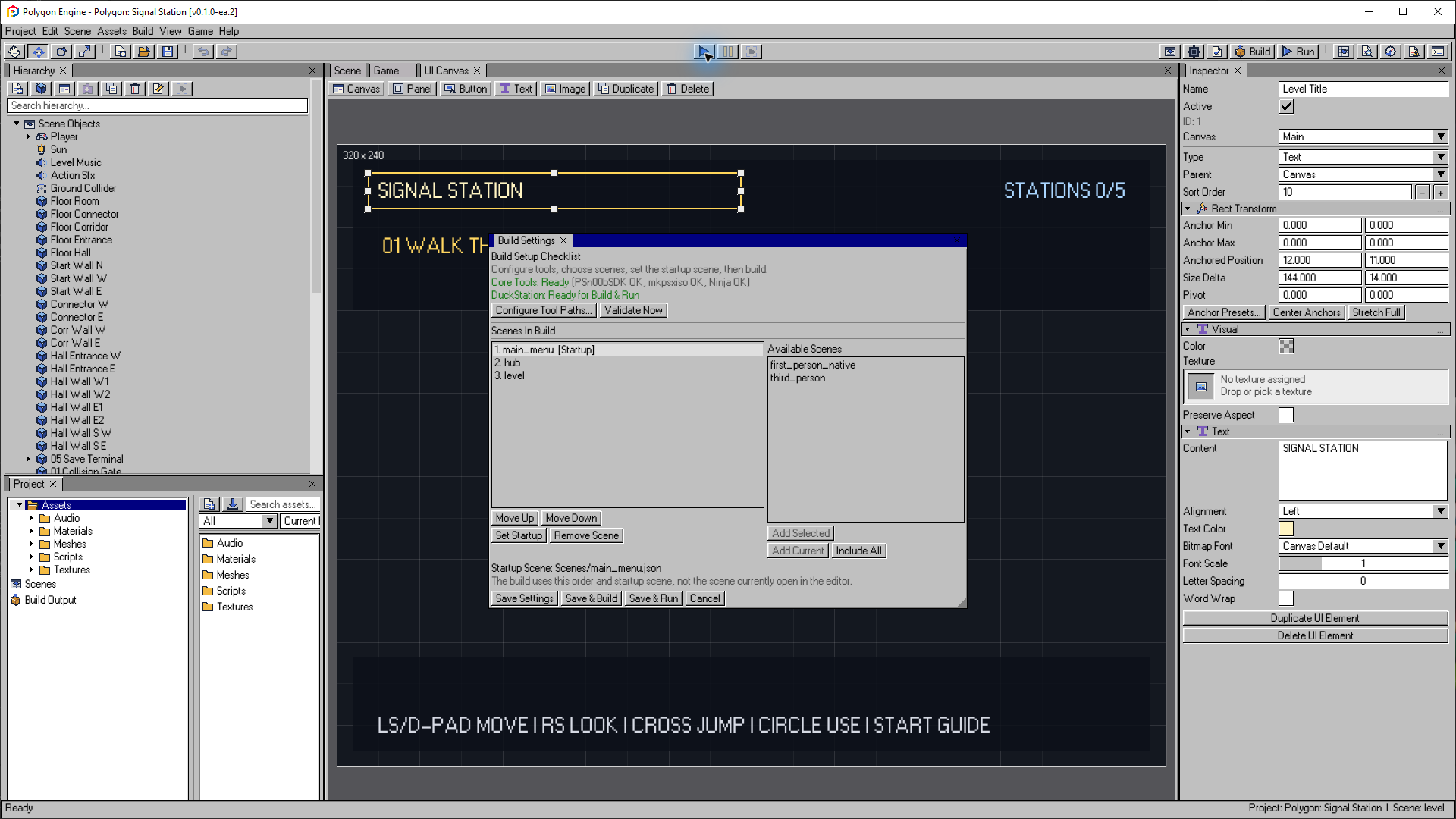
Set the startup scene and include every scene the game can load. This example lists Signal Station scenes; your project will have its own scene list.
Open the image to view it at full size.Pipeline Stages
Validate Project
  -> check tool paths, scene list, startup scene, scripts, assets, stale imports, budgets

Select Runtime
  -> use the precompiled Debug or Release Polygon Engine runtime
  -> private source checkouts may compile it with PSn00bSDK and Ninja

Stage disc_root
  -> write SYSTEM.CNF, POLYGON.EXE, DATA/MANIFEST.JSN
  -> reimport stale textures/audio when source or import settings changed
  -> stage scenes, scripts, meshes, materials, textures, and audio
  -> validate and stage referenced hard-skinned animation assets
  -> encode enabled streaming-music WAV files as CD-XA
  -> bake PS1-safe primitive geometry into runtime mesh chunks
  -> bake enabled navigation surfaces into deterministic height-aware node/link graphs
  -> reject overlong runtime strings before writing .BSN data
  -> write bounded BSN data plus sized scene-feature chunks
  -> write one sector-aligned sequential dependency bundle per built scene
  -> write post-bake PS1 budget and performance reports

Package
  -> write mkpsxiso XML
  -> generate .bin, .cue, and .iso under Build/ps1/package
  -> write logs and burn guidance
Output Folders
| Path | Description |
|---|---|
Build/ps1/disc_root/ | Internal staged disc contents |
Build/ps1/package/ | User-facing package output |
Build/ps1/logs/ | Build summary, authoring budgets, post-bake runtime budgets, performance report, build log, and packaging log |
Library/build_history.json | Last 20 local build summaries |
The package folder is the one most users should inspect after a successful build.
Completion Summary
The completion dialog reports the result, duration, configuration, startup scene, and generated CUE/BIN/ISO/XML sizes. It can open the package, launch the existing package in DuckStation, or copy a compact summary for a support report.
Build/ps1/logs/build_summary.json stores the latest result, including the
failure step and message when a build stops. Library/build_history.json
retains the last 20 summaries. These files support local diagnosis; the package
and authoritative post-bake reports remain the release evidence.
Staged Runtime Data
The PS1 runtime expects a compact staged layout. A typical build includes:
Build/ps1/disc_root/
  SYSTEM.CNF
  POLYGON.EXE
  DATA/
    MANIFEST.JSN
    S/  scenes
    L/  Lua scripts
    M/  meshes
    K/  hard-skinned animation assets
    R/  materials
    T/  textures
    A/  resident VAG audio
    X/  streaming CD-XA music (when present)
    B/  scene-local sequential bundles
DATA/MANIFEST.JSN maps runtime GUIDs and scene names to these compact staged
disc paths. The editor still shows friendly project categories such as Scenes,
Scripts, Meshes, Materials, Textures, and Audio; the short folder names exist
only to reduce manifest text and CD path overhead on PS1.
Each built scene also receives a scene-local .PGB bundle containing its
binary scene and ordered dependencies. The manifest maps the scene to that
bundle, allowing the runtime to perform sequential CD reads with fewer seeks.
Loose staged assets remain available as a bounded fallback and as the canonical
manifest paths; authors do not reference .PGB files directly.
Each manifest scene entry also carries the destination scene's compact loading
screen configuration. The runtime can select that presentation before reading
the destination .BSN, which makes the correct loading screen available from
the transition's first frame. The LOAD BSN chunk remains the scene-resident
copy of the same authored settings.
Post-Bake Budget Reports
The build pipeline validates both authoring data and final PS1 runtime data. The
authoring estimate catches missing references early. The post-bake report is the
source of truth because it is generated after primitives are converted into mesh
chunks and after scenes are written as binary .BSN files.
Important generated files:
| File | Purpose |
|---|---|
ps1_budget_current_scene.json | Current scene budget; overwritten with post-bake data during build |
ps1_runtime_budget_<scene>_<hash>.json | One authoritative post-bake budget per built scene |
ps1_build_performance_report.json | Build-level manifest, runtime memory, global asset, and scene summary |
The build-level report also records the selected video region and target refresh
rate. Acceptance checks that the project, report and staged MANIFEST.JSN agree.
Warnings appear when a scene approaches fixed PS1 limits such as GameObject count,
mesh cache, manifest cache, packet buffer, binary scene load size, or runtime
RAM headroom. .BSN scene data is treated as loader transient memory; the
runtime report separates that peak from persistent mesh and Lua memory. Hard
issues stop the build before packaging.
The build-level report now carries one canonical readiness field:
PS1 Ready, Needs optimization, or Build blocker. Production acceptance
requires PS1 Ready across the build, not merely a successful ISO/BIN/CUE.
The current production targets for official templates are:
| Budget | Production target |
|---|---|
| Runtime RAM | At least 160 KB free inside the PS1-safe runtime budget |
| Manifest text | At or below 70% of the 16 KB manifest buffer |
| Binary scene read size | At or below 65% of the 160 KB scene load buffer |
| Packet estimate | At or below 80% of the 96 KB packet buffer |
Release and acceptance builds require a real runtime memory report. Package-only flows may reuse staged content, but they are not considered authoritative if the runtime memory data is missing.
Binary Scene Data
Current builds write bounded .BSN scene data. The core GameObject and UI
payload is followed by tagged, byte-sized feature chunks:
| Chunk | Data |
|---|---|
RNDR | Distance fog and per-Mesh Renderer color/fog/Room policy |
LOAD | Loading-screen presentation and timing |
UIEX | Bitmap fonts and extended UI/ProgressBar fields |
UICV | Named canvas definitions and element-to-canvas bindings |
INTR | Interactable button, cooldown, repeatability, and prompt-canvas fields |
WRLD | Rooms and Portals |
NAVG | Navigation components plus baked nodes and links |
TIME | Cutscene clips, tracks, and keyframes |
ANIM | Standalone Animation clips, tracks, and keyframes |
SKEL | Scene Animator bindings |
Sized unknown chunks can be skipped safely, while malformed or truncated known chunks fail with an explicit scene-load error. Rebuild projects after upgrading so the current writer and validation rules check every supported feature.
Validation Coverage
Validation is part of the product, not an optional debug step. It catches issues such as:
- missing required runtime or packaging tools (SDK/CMake/Ninja only for source builds; DuckStation only for Run),
- startup scene not included in Scenes In Build,
- scenes referenced by build settings that do not exist,
- missing mesh, texture, material, audio, or script assets,
- stale texture or audio imports when source files or settings changed,
- XA encoding failures or more than 8 streaming-music tracks,
- scene-bundle dependency, path, or package-generation failures,
- UI callbacks that reference missing Lua functions,
- Lua heap, script size, and script count limits,
- Level Builder meshes without Colliders,
- bitmap font scales outside the integer
1..4range, imported atlases whose actual dimensions cannot contain the declared glyph grid, or invalid ProgressBar values, - broken Room/Portal, renderer-room, NavMesh Surface, or NavMesh Agent references,
- navigation bake capacity errors,
- invalid cutscene targets, times, interpolation, events, or fixed capacities,
- invalid standalone Animation tracks, targets, times, completion-safe capacities, or unsupported cutscene-only track types,
- invalid skeletal assets, clips, bindings, hard-skin geometry, material count, or scene geometry/matrix/scratch budgets,
- overlong
.BSNstrings such as GameObject names, spawn IDs, prompts, Lua callback names, Input Action names, Animator states, or UI text, - risky PS1 geometry such as large unsegmented built-in primitives,
- transparent or double-sided materials that may need careful ordering,
- post-bake binary scene, manifest, mesh, script, audio, animation, and runtime memory limits.
Hard errors should be fixed before building. Warnings should be treated as production risks.
Disc Images
The package step can generate .bin, .cue, and .iso artifacts. For real PS1 disc burning, use the .cue file because it describes the raw BIN image layout expected by PS1 tools.
DuckStation testing normally uses the generated package output.
Troubleshooting Checklist
| Symptom | First places to check |
|---|---|
| Runtime cannot load a scene | Build Settings, startup scene, Scenes In Build, DATA/MANIFEST.JSN |
| Runtime cannot load a script | Script component path, staged DATA/L, build validation |
| Missing texture or material | Asset database entry, material GUID, staged DATA/T and DATA/R |
| Texture or audio changed but build looks old | Reimport status in Project Browser, source hash/settings hash warnings |
| Streaming music does not play | Streaming Music flag, track filename stem, staged DATA/X, Music.Play() return value |
| Object can be walked through | Collider component, Level Builder placement, Collider trigger flag |
| Build fails at packaging | mkpsxiso path, package logs, locked files in Build/ps1/package |
| Build & Run is disabled or fails | DuckStation path and generated .cue |
For practical menu usage, see Workflow: Build & Export.
For common failures and runtime load errors, see Troubleshooting.
Testing the package
Rebuild after updating the editor or changing assets. Use a Debug build to investigate script errors and a Release build for final testing. A successful build is followed by gameplay testing: check controls, UI, frame rate, scene transitions, audio, and saving in the packaged game.
See Budget Dashboard for the meaning of PS1 Ready and the next testing steps.