3. Create the Door Trigger and Lua
The door will open when the player crosses an invisible volume. One Lua script will own the trigger, checkpoint position, persistent door state, UI callbacks, and reset path.
Create the Trigger GameObject
- Select Scene > Create Entity > Create Empty and keep it at the scene root,
separate from
DoorandPlayer. Disabling Door must not disable its controller. - Rename the GameObject
Door Trigger. - Set its Transform Position to
(0, 1.0, -2.25). - In the Inspector, select Add Component > Collider.
- Set Type to AABB and Size to
(1.6, 2.0, 1.0). HoldCtrland click a numeric field to type an exact value, then press Enter. - Enable Is Trigger.
The trigger sits immediately before the door when approaching from Room A. It must overlap the player capsule but must not block movement.
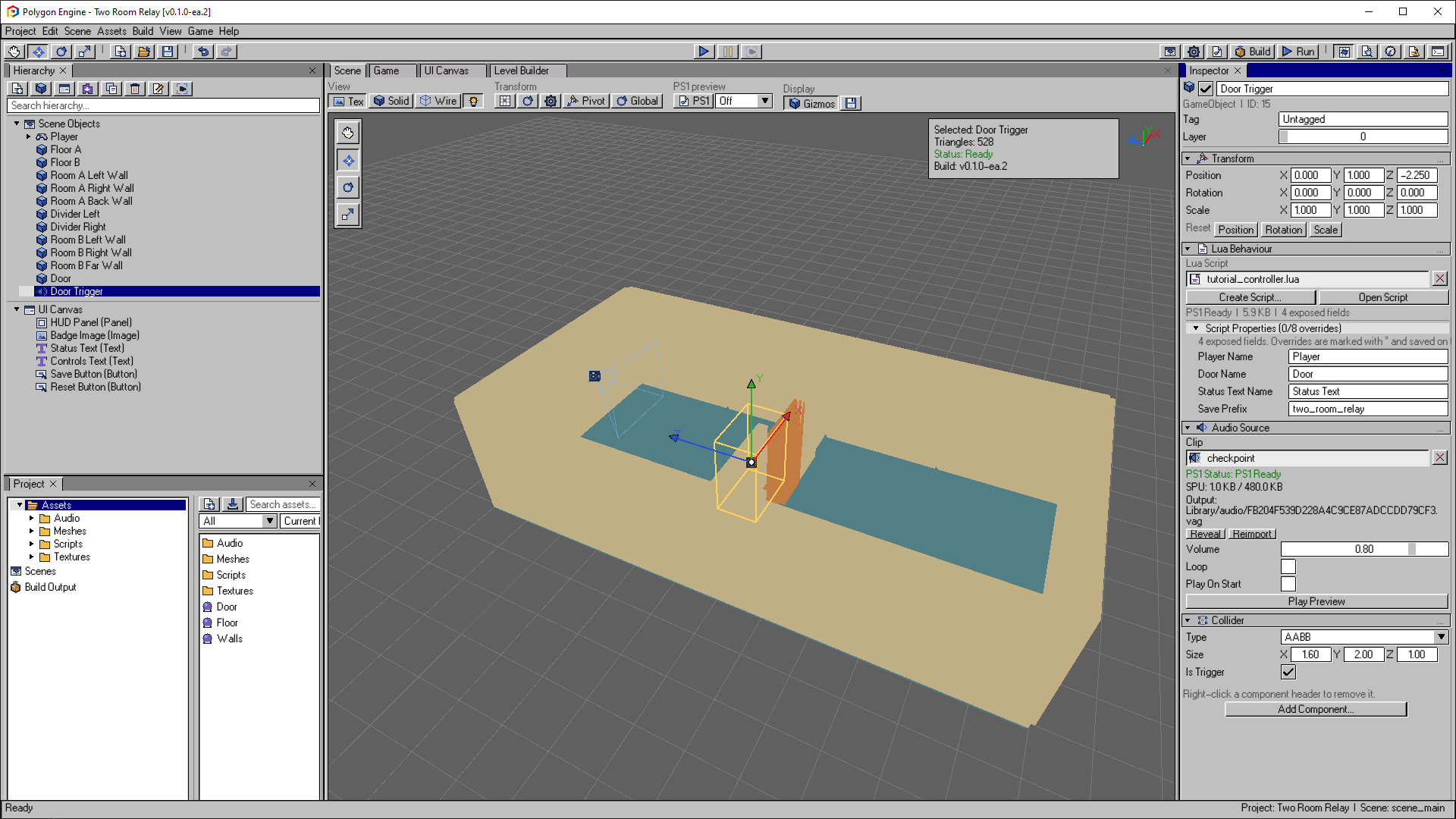
The finished Door Trigger sits on the Room A side of the doorway. The Inspector shows the script name bindings, checkpoint sound and trigger dimensions. Audio is added in the next chapter.
Open the image to view it at full size.Create and Attach the Script
- With
Door Triggerselected, choose Add Component > Lua Behaviour. - The Select Lua Script dialog opens. Select Create New. If you already added an empty Lua Behaviour, its Create Script... button opens the same creation workflow.
- Name it
tutorial_controller.lua, select the Behaviour template, and place it inAssets/Scripts, then select Create. - Select Open Script.
- Replace the generated contents with the code below and save the file.
You can also download the
complete script
and copy it over the generated file at Assets/Scripts/tutorial_controller.lua.
Return to the engine and confirm that the Lua Behaviour shows the script as PS1 Ready.
-- Exposed Inspector properties. Keep these names unique in the scene.
playerName = "Player"
doorName = "Door"
statusTextName = "Status Text"
savePrefix = "two_room_relay"

local playerId = -1
local doorId = -1
local statusId = -1
local startPosition = nil
local doorOpen = false
local fields = { "x", "y", "z", "door_open" }

local function key(name)
    return savePrefix .. "." .. name
end

local function status(message)
    Log.Print(message)
    if statusId >= 0 then
        local display = string.sub(message, 1, 62)
        if #display > 32 then
            display = string.sub(display, 1, 32) .. "\n" .. string.sub(display, 33)
        end
        Text.SetText(statusId, display)
    end
end

local function valid_targets()
    if not GameObject.Exists(playerId) or not GameObject.Exists(doorId) then
        status("SETUP ERROR: CHECK PLAYER AND DOOR NAMES")
        return false
    end
    return true
end

local function set_door(open)
    if not GameObject.SetActive(doorId, not open) then
        status("SETUP ERROR: DOOR IS UNAVAILABLE")
        return false
    end
    doorOpen = open
    return true
end

local function capture_preferences()
    local previous = {}
    for _, name in ipairs(fields) do
        if PlayerPrefs.HasKey(key(name)) then
            previous[name] = name == "door_open"
                and PlayerPrefs.GetInt(key(name), 0)
                or PlayerPrefs.GetFloat(key(name), 0.0)
        end
    end
    return previous
end

local function clear_preferences()
    for _, name in ipairs(fields) do
        -- An absent key returns false; deleting it is already complete.
        PlayerPrefs.DeleteKey(key(name))
    end
end

local function restore_preferences(previous)
    -- Release newly inserted keys first, including a partially written set.
    clear_preferences()
    for _, name in ipairs(fields) do
        local value = previous[name]
        if value ~= nil then
            if name == "door_open" then
                PlayerPrefs.SetInt(key(name), value)
            else
                PlayerPrefs.SetFloat(key(name), value)
            end
        end
    end
end

local function save_checkpoint(hostId, message)
    if not valid_targets() then return false end
    local position = Transform.GetPosition(playerId)
    if position == nil then
        status("SAVE FAILED: PLAYER IS UNAVAILABLE")
        return false
    end
    local previous = capture_preferences()
    local written = PlayerPrefs.SetFloat(key("x"), position.x)
        and PlayerPrefs.SetFloat(key("y"), position.y)
        and PlayerPrefs.SetFloat(key("z"), position.z)
        and PlayerPrefs.SetInt(key("door_open"), doorOpen and 1 or 0)
    if not written or not PlayerPrefs.Save() then
        local reason = SaveData.GetLastError()
        restore_preferences(previous)
        status("SAVE FAILED - RETRY SAVE: " .. reason)
        return false
    end
    status(message)
    AudioSource.Play(hostId)
    return true
end

local function teleport(position)
    if not Transform.SetPosition(playerId, position.x, position.y, position.z) then
        status("LOAD FAILED: INVALID PLAYER POSITION")
        return false
    end
    CharacterController.SetVelocityY(playerId, 0.0)
    return true
end

local function load_checkpoint()
    if not valid_targets() then return false end
    local previous = capture_preferences()
    if not SaveData.Reload() then
        local reason = SaveData.GetLastError()
        -- Keep this checkpoint available when loading fails.
        restore_preferences(previous)
        status("LOAD FAILED: " .. reason)
        return false
    end
    for _, name in ipairs(fields) do
        if not PlayerPrefs.HasKey(key(name)) then
            status("NO CHECKPOINT")
            return false
        end
    end
    local position = {
        x = PlayerPrefs.GetFloat(key("x"), 1e30),
        y = PlayerPrefs.GetFloat(key("y"), 1e30),
        z = PlayerPrefs.GetFloat(key("z"), 1e30)
    }
    if not teleport(position) then return false end
    if not set_door(PlayerPrefs.GetInt(key("door_open"), 0) == 1) then return false end
    status("CHECKPOINT LOADED")
    return true
end

function Start(gameObjectId)
    statusId = UI.Find(statusTextName)
    playerId = GameObject.Find(playerName)
    doorId = GameObject.Find(doorName)
    if not valid_targets() then return end
    startPosition = Transform.GetPosition(playerId)
    set_door(PlayerPrefs.GetInt(key("door_open"), 0) == 1)
    local saveButton = UI.Find("Save Button")
    if saveButton >= 0 then Selectable.Select(saveButton) end
    status(doorOpen and "DOOR OPEN - SQUARE LOADS" or "WALK TO THE DOOR")
end

function Update(gameObjectId, dt)
    if Input.GetButtonDown(Input.SQUARE) then load_checkpoint() end
end

function OnTriggerEnter(gameObjectId, otherGameObjectId)
    if otherGameObjectId ~= playerId or doorOpen then return end
    if not valid_targets() or not set_door(true) then return end
    -- An unavailable card never blocks walking into Room B.
    -- Save retries persist this live door state and the current player position.
    save_checkpoint(gameObjectId, "DOOR OPEN - CHECKPOINT SAVED")
end

function saveNow(gameObjectId, elementId, elementName, eventName)
    save_checkpoint(gameObjectId, "CHECKPOINT SAVED")
end

function resetProgress(gameObjectId, elementId, elementName, eventName)
    if not valid_targets() or startPosition == nil then return end
    local previous = capture_preferences()
    clear_preferences()
    if not PlayerPrefs.Save() then
        local reason = SaveData.GetLastError()
        restore_preferences(previous)
        status("RESET FAILED: " .. reason)
        return
    end
    -- Return to Room A before closing the door, so reset cannot trap the player.
    if not teleport(startPosition) then return end
    if not set_door(false) then return end
    status("PROGRESS RESET")
end
Connect the Script Properties
Return to Polygon Engine and select Door Trigger. The Lua Behaviour component reads
the top-level declarations before the first function and exposes them under
Script Properties.
Set:
| Script property | Value |
|---|---|
| Player Name | Player |
| Door Name | Door |
| Status Text Name | Status Text |
| Save Prefix | two_room_relay |
The script resolves these exact, unique names once in Start and caches their
IDs. Keep both objects enabled in the authored scene; Start applies the saved
door state after binding the references.
A missing name produces a setup error instead of silently disabling the puzzle.
An asterisk in the Inspector means the GameObject overrides the Lua default.
What the Script Does
Startrestores the saved door state.OnTriggerEnterchecks that the entering GameObject is the player, opens the door, saves the checkpoint, and flushes it.Updateexplicitly reloads the persisted document before loading on Square.- A failed save preserves the previous tutorial preferences in RAM, keeps the live door open, and offers retry through Save. A failed reset keeps the live door/player state unchanged. A successful reset returns the player to Room A.
saveNowandresetProgressare callbacks for authored UI buttons.AudioSource.Play(hostId)will use the trigger's Audio Source after the next chapter adds it.
Checkpoint 3
Press Ctrl+S and enter Play Mode. Walk toward the door. The door should
disappear and allow entry into Room B. The Console must not report a missing
script, setup or trigger error. The initial save can fail if no writable save device
is available; the door still opens, and the next chapter adds visible feedback.
The status text and audio do not exist yet, so their visible feedback comes in the next chapter: Add UI, Audio, and Saving.